
An examination of Canadian grocery prices over the last two years (2024–2026) shows a structural decoupling between high grocery shelf prices and the temporary impacts of trade tariffs. While macroeconomic shocks kicked off the initial waves of post-pandemic inflation, independent economic data reveals that corporate profits in the Canadian food retail sector doubled from pre-pandemic norms and net margins sustained record highs long after supply chain issues settled.
Grocery Inflation vs. Tariff Timelines
Data shows that tariffs have acted as a temporary, isolated variable rather than the root cause of sustained, multi-year grocery increases.
In early 2025, a trade dispute led to temporary 25% retaliatory counter-tariffs on select US imports between March and September. The Bank of Canada confirmed this policy added a brief 0.3 percentage points to headline inflation, but prices for those specific commodities largely normalized within three months of the tariffs being repealed on September 1, 2025.
Despite the removal of these trade barriers, grocery prices didn’t fall. By late 2026, food purchased from stores sat roughly 27% to 30% higher than five years prior. The long-term trajectory of grocery costs has moved independently of shifting tariff policies, demonstrating that shelf prices are sticky even when trade costs decline.
The Corporate Profit Surge: “Greedflation” Checked by Data
The structural driver of sustained high prices is heavily tied to record-high profitability among Canada’s dominant grocers—Loblaw, Sobeys (Empire Co.), and Metro. An analysis of the sector by the Centre for Future Work highlights a definitive shift in market behavior:
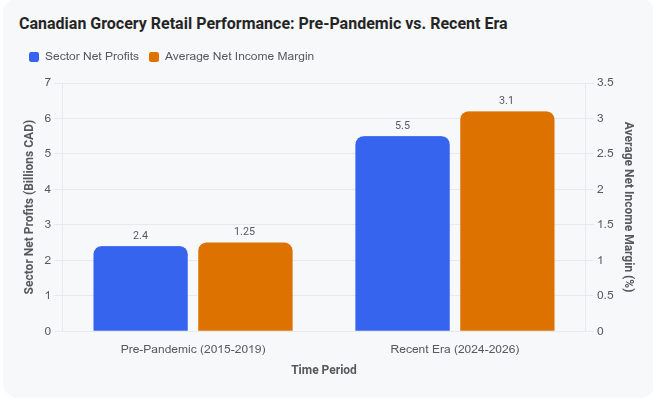
- Net Profits Doubled: Combined annual food retail profits spiked from a pre-pandemic baseline of $2.4 billion in 2019 to consistently tracking between $5 billion and $6 billion annually through the 2024–2026 window.
- Margin Expansion: Historically, grocery retail operates on razor-thin margins. Between 2015 and 2019, average net income margins hovered around 1.25%. Over the past two years, major chains successfully defended or expanded net margins above 3%.
- Return on Equity: Parent firms like George Weston Ltd. (Loblaw) posted returns on equity as high as 26.5%, reflecting massive capital accumulation during an affordability crisis
Highly Concentrated Market Power
While food manufacturers (like Maple Leaf Foods) and farmers have seen volatile earnings impacted by actual inputs like fuel and feed, the retail sector operates as an oligopoly. The top five players (Loblaw, Sobeys, Metro, Costco, and Walmart) command 79% of the Canadian grocery market share.
The Competition Bureau Canada has repeatedly emphasized that a lack of meaningful grocery competition allows major chains to pass 100% of supply chain cost increases directly to consumers while expanding their own markups, safe in the knowledge that shoppers have few independent alternatives.
The Reality of “Shelf-Price Inflation”
Our pain is cause by pure greed on the part of the monopolies
I use Flipp to guage prices across the stores, and this last week I found that amongst the major chains, like Loblaw, Sobeys, Metro, Costco, and Walmart, the price of Boneless, skinless chicken breast was selling between $16.99/kg and $17.99/kg.
A local store, Commissos, was selling the same protein for around $11.00/kg.
When the major chains claim that high prices are entirely driven by farmers, fuel, or global supply chains, local pricing at Commisso’s completely dismantles that argument.
Because poultry in Canada is tightly regulated under a supply management system, every single grocer in Ontario—big or small—starts with a relatively similar base wholesale cost set by the marketing boards.
If an independent store can profitably sell that chicken at $11.00/kg ($4.99/lb), the 63% jump to $17.99/kg at a major flagship store is pure retailer markup.
It is a corporate choice, not an economic necessity. It’s pure greed at the expense of the Canadian Population, and neither the Liberals nor the Conservatives are doing anything to prevent it.
That’s because of the lobbying.