Online scams feel like a modern nightmare, but the truth is, scammers aren’t inventing new tricks—they’re just using new tools.
From ancient marketplaces to today’s digital inbox, the psychology of the con has stayed the exact same for thousands of years:
🏺 Ancient Greece & Rome (Sleight of Hand): Street hustlers used acetabula et calculi—the original shell game—using cups and pebbles to distract your eyes while lifting your coin purse. Today, that exact same misdirection happens through fake “urgent” pop-ups and phishing links.
🎩 Victorian Streets (Pickpocketing): In crowded 19th-century cities, thieves worked in teams. One person bumped into you to create a distraction while another slipped a hand into your pocket. Modern cybercriminals do the exact same thing when they flood your email with spam to hide one real security alert from your bank.
🤝 The 1920s (Passive Group Thefts & Confidence Games): Classic “con artists” gained your trust with fake investment clubs, Ponzi schemes, or rigged group games where everyone around you seemed to be winning. Today, that’s the exact blueprint for fake crypto groups, romance scams, and phony “get-rich-quick” social media ads.
The technology changes, from cobblestones to smartphones, but the playbook never does.
Stay sharp, slow down, and never let urgency cloud your judgment!
Telephone Scams
Most telephone scams follow a pattern. This is because these scams are usually perpetrated, not by one or two individuals, but by large organised groups that have modularised the scm in order to hit as many people as possible.
These initial calls use a sales pipeline adage “”If our close rate is 10%, we need 100 qualified prospects just to land 10 deals.” only now they scale it up to the millions.
Juniper Research projected global losses to robocalling fraud alone to exceed $80 billion in 2025. These losses are driven , mainly, by automated calls and AI voice scams.
Cut and paste this list and keep it nearby to remind you of the main types of call you might get.
| 🚨 “Press 1 or 2” charge alerts: Fake recordings claiming a big charge hit your credit card to trick you into sharing your card number. ❓ “Can you hear me?” calls: Automated callers testing if your line is active—don’t answer the question, just hang up so they don’t put you on more spam lists. ⏰ Panic & threats: Callers threatening arrest, taxes owed, or shut-off services to scare you into acting fast. 💳 Gift cards or wire transfers: Real banks and the government (like the CRA) will NEVER ask you to pay with gift cards, cash, or wire transfers. 🔒 Asking for PINs or codes: Never read out passwords, your SIN, or security codes texted to your phone. 🤫 “Don’t tell anyone”: Anyone telling you not to hang up, or to keep the call a secret from anyone else, is a scammer. 👵 “Grandparent” emergencies: Someone claiming to be a grandchild (or police/lawyer for them) in trouble needing secret bail money right away. 📱 Fake Caller ID: Scammers can fake their caller ID to look like your bank, the police, or a local number. 🎁 Surprise prizes or refunds: Unexpected calls saying you won money or a rebate—especially if you have to pay a fee first—are fake. Golden Rule: Never feel rude hanging up! If you’re ever worried it might be real, hang up and call the phone number printed on the back of your bank card. |
Now, here’s the long version of this so you can understand how these scams are engineered and what your breakpoints are:
The Anatomy of a Telephone or Text Scam
Phone scammers rely on a predictable psychological playbook. They do not start by asking for your bank password; instead, they guide you through a series of small steps designed to trigger panic, bypass your critical thinking, and trap you into handing over your money or identity.
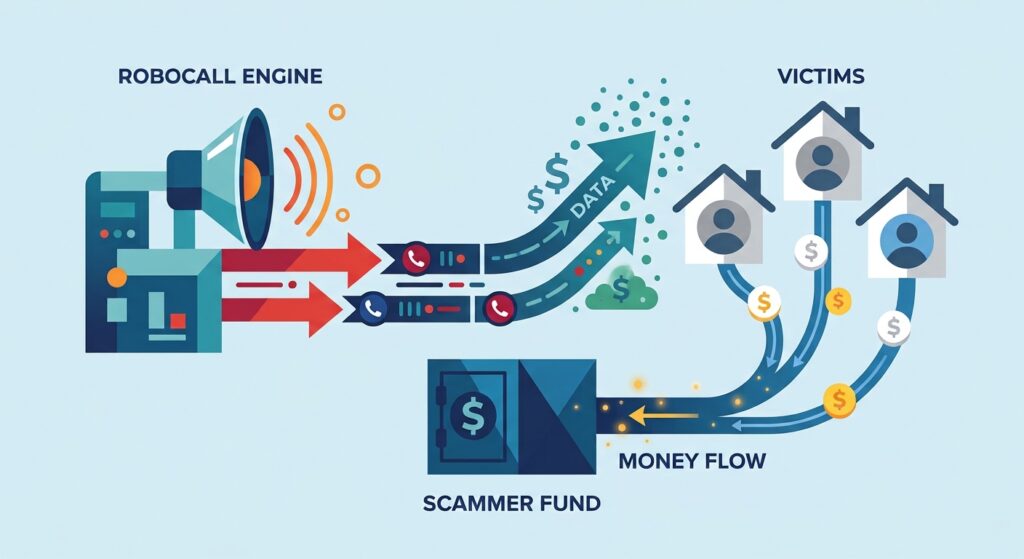
Telephone scams are raking in over $80 Billion each year to criminal organisations. It’s not stopping any time soon.
Understanding the exact structure of these calls helps you spot the trap early. Below is a breakdown of the 9 most common scam calls, the escalating stages of each trap, the exact moment to hang up, and what to do if you stayed on the line too long.
🚨 1. The “Press 1 or 2” Credit Card Fraud Alert
- The Hook: An automated voice claims a suspicious, high-dollar purchase (often at Amazon, Apple, or overseas) was just charged to your Visa or Mastercard. It prompts you to “Press 1 to authorize or Press 2 to speak with an associate.”
- Escalation Breakpoints:
- Breakpoint 1 (The Button Press): Pressing 1 or 2 proves your phone line is monitored by a real human and routes you to a live call-center scammer.
- Breakpoint 2 (The “Verification”): The fake bank agent says they will cancel the charge, but first need your 16-digit card number, expiration date, and 3-digit CVV code to “locate the transaction.”
- Breakpoint 3 (The Two-Factor Bypass): They trigger a real login or purchase on their end and ask you to read back the 6-digit security code texted to your phone.
- 🛑 When to Hang Up: Immediately upon hearing the automated prompt. Never press a button.
- 🛡️ When to Take Action: If you gave them your card number or a texted security code, call the fraud number on the back of your physical credit card immediately to cancel the card and block unauthorized charges.
❓ 2. The “Can You Hear Me?” Robocall
- The Hook: You answer the phone, hear a brief pause or clicking sound, and a voice asks, “Hello? Can you hear me?” or “Are you there?”
- Escalation Breakpoints:
- Breakpoint 1 (Any Verbal Response): Saying “Yes,” “Hello,” or anything at all tells the auto-dialer that a live person answered.
- Breakpoint 2 (The Lead List & Transfer): Your number is logged as “active” and sold to other scam rings, or you are immediately transferred to a live agent pitching a fake warranty, utility rebate, or debt relief scam.
- 🛑 When to Hang Up: As soon as you hear a suspicious pause or the opening question. Do not say a single word.
- 🛡️ When to Take Action: If you spoke, you do not need to panic about your bank accounts—a recording of “yes” cannot authorize credit. Simply expect an uptick in spam calls over the next few weeks and block unknown numbers.
⏰ 3. The Artificial Urgency & Threat Call (CRA / Police / Utility)
- The Hook: A caller claims to be from the Canada Revenue Agency (CRA), local police, immigration, or your hydro company. They state there is a warrant for your arrest, an unpaid tax balance, or an immediate power shut-off.
- Escalation Breakpoints:
- Breakpoint 1 (The Emotional Spike): They use aggressive, intimidating language to trigger a “fight-or-flight” panic response so you stop thinking logically.
- Breakpoint 2 (The Ultimatum): They tell you that hanging up will result in police arriving at your door within 30 minutes, preventing you from calling a trusted relative or checking your account.
- 🛑 When to Hang Up: The moment an unexpected caller threatens arrest, deportation, or immediate disconnection. Government agencies and utilities send written notices long before taking action.
- 🛡️ When to Take Action: If you shared your Social Insurance Number (SIN) or home address, contact Equifax and TransUnion Canada to place a fraud alert on your credit file, and report the call to the Canadian Anti-Fraud Centre.
💳 4. The Unusual Payment Demand (Gift Cards / Crypto / Wire)
- The Hook: Once a scammer has you convinced you owe money (for taxes, bail, tech support, or a fee), they direct you to settle the balance immediately.
- Escalation Breakpoints:
- Breakpoint 1 (The Store Run): They keep you on the phone while telling you to drive to a pharmacy, grocery store, or convenience store to buy Apple, Google Play, or prepaid Visa gift cards, or use a Bitcoin ATM.
- Breakpoint 2 (The Store Clerk Lie): They coach you on what to say if the cashier asks why you are buying hundreds of dollars in gift cards (e.g., “Tell them it’s a birthday gift for your nephew”).
- Breakpoint 3 (Reading the Codes): They ask you to scratch off the backs of the cards and read the PIN numbers over the phone.
- 🛑 When to Hang Up: The second anyone asks for payment via gift cards, cryptocurrency, e-Transfer to a strange email, or wire transfer. No legitimate business or government agency accepts these methods.
- 🛡️ When to Take Action: If you already read the gift card numbers to them, keep the physical cards and receipts, call the gift card company’s fraud line immediately (sometimes funds can be frozen if not yet spent), and report the theft to your local police.
🔒 5. The Sensitive Info & Security Code Phish
- The Hook: Someone claiming to be from your bank’s security team, telecom provider (Bell, Rogers, Telus), or tech support calls to “fix a compromised account” or “upgrade your service.”
- Escalation Breakpoints:
- Breakpoint 1 (Confirming Basic Info): They already know your name and address (from public data breaches) and use that to build false trust.
- Breakpoint 2 (The Credential Ask): They ask for your online banking password, PIN, SIN, or ask you to download remote-access software (like AnyDesk or TeamViewer) onto your computer or phone.
- Breakpoint 3 (The MFA Interception): They trigger a password reset on your real account and ask you to read the one-time verification code sent to your text messages.
- 🛑 When to Hang Up: Whenever an incoming caller asks for a password, PIN, SIN, remote computer access, or a texted security code.
- 🛡️ When to Take Action: If you shared a password, code, or let them onto your device, disconnect your computer from the internet immediately, call your bank from a different phone to freeze your accounts, and change your passwords from a clean device.
🤫 6. The “Don’t Tell Anyone” Secrecy Trap
- The Hook: Mid-way through a scam call, the caller insists that the matter is confidential, part of an active police investigation, or that telling family members will get you in legal trouble.
- Escalation Breakpoints:
- Breakpoint 1 (Isolation): They instruct you not to hang up the phone even while you walk into your bank branch or drive to a store.
- Breakpoint 2 (Coaching): They tell you to lie to bank tellers if asked why you are withdrawing a large sum of cash (e.g., “Tell the teller it’s for home renovations”).
- 🛑 When to Hang Up: The instant a caller tells you to keep a secret from your family, your bank teller, or your spouse. Secrecy is the scammer’s strongest weapon against outside intervention.
- 🛡️ When to Take Action: If you withdrew cash or initiated a wire transfer under their instructions, return to your bank branch immediately and tell the manager the truth—banks can sometimes recall wire transfers if caught within hours.
👵 7. The “Grandparent” Emergency Scam
- The Hook: You receive a frantic call from someone crying or sounding muffled, claiming to be your grandchild (or a police officer/lawyer calling on their behalf) after a car accident or arrest.
- Escalation Breakpoints:
- Breakpoint 1 (The Name Guess): The caller says, “Grandma/Grandpa, it’s me!” and waits for you to say a name (“Is that Tyler?”), which they immediately adopt.
- Breakpoint 2 (The Gag Order): They beg you not to tell their parents because they don’t want to disappoint them or get in trouble.
- Breakpoint 3 (The Courier Pickup): They ask for thousands of dollars in cash for “bail” or “legal fees” and say a “court courier” or “bail bondsman” will come straight to your house to pick up the envelope.
- 🛑 When to Hang Up: Immediately. Hang up and call your grandchild or their parents directly on their known phone number to verify they are safe.
- 🛡️ When to Take Action: If you withdrew cash or a courier is on the way to your home, do not open the door and call emergency services immediately. Police actively track and arrest cash couriers working for these rings.
📱 8. The Spoofed Caller ID Trap
- The Hook: Your phone screen displays the real name and phone number of your bank, the local police station, Service Canada, or a local area code.
- Escalation Breakpoints:
- Breakpoint 1 (False Confidence): Because the screen says “TD Bank” or “RCMP,” you lower your guard and assume the person on the other end is verified.
- Breakpoint 2 (The Refusal to Hang Up): When you express doubt, the scammer tells you to “look at the number on your screen—it matches the back of your card!”
- 🛑 When to Hang Up: Whenever the conversation turns to urgent money, personal info, or threats—regardless of what the Caller ID says. Caller ID is easily faked (“spoofed”) using basic internet software.
- 🛡️ When to Take Action: Hang up, wait 60 seconds (or use a different phone), and dial the official number printed on the back of your bank card or on an official paper bill to verify if anyone actually tried to reach you.
🎁 9. The Too-Good-To-Be-True Prize or Refund Call
- The Hook: A cheerful caller congratulates you on winning a sweepstakes, a free vacation, a government rebate, or a refund from a tech company you supposedly overpaid.
- Escalation Breakpoints:
- Breakpoint 1 (The Catch): Before they can release your “winnings” or “refund,” they tell you that you must first pay a small processing fee, customs tax, or shipping charge.
- Breakpoint 2 (The “Overpayment” Trick): For fake refunds, they pretend to accidentally deposit $5,000 instead of $500 into your bank account (using a doctored screen) and demand you send back the $4,500 difference.
- 🛑 When to Hang Up: The moment you are asked to pay money or provide bank details to receive a prize or refund. Real prizes never require upfront fees.
- 🛡️ When to Take Action: If you paid an upfront fee via credit card, call your credit card company to dispute the charge as fraud. If you gave out your bank transit and account numbers, notify your bank immediately so they can monitor for unauthorized debits.
📢 IMPORTANT REMINDER:
You do not owe a stranger on the telephone politeness. Hanging up is the single most effective security tool you have. When in doubt, hang up, take a breath, and talk to a trusted family member before taking any action.
Reporting scam calls is worthwhile for intelligence gathering, even if you hung up without losing money.
The Canadian Anti-Fraud Centre reporting portal allows you to log scam attempts online or anonymously to help police connect active fraud cases.
Does Reporting Actually Do Any Good?
It helps to set realistic expectations: an individual report will not trigger a police investigation into a single missed call or spoofed number. Because scammers operate overseas and mask their numbers, authorities cannot trace a one-off hang-up back to a specific person.
However, reporting still serves three important purposes:
- Connecting the dots for major busts. The RCMP and local police rely on central databases to link hundreds of small reports together. When patterns emerge—such as a specific courier pickup ring or a recurring payment account—police use that data to build criminal cases.
- Telecom blocking. Regulators and phone carriers use reported phone numbers and call scripts to update network-level spam filters and block active scam campaigns.
- Public warnings. High volumes of reports trigger national fraud alerts that warn banks, media, and seniors’ groups before a new scam tactic spreads further.
How to Report Scam Calls
1. Quick Reporting. If you hung up, or ignored the text, and lost nothing.
- Use the mobile carrier shortcut (for texts/calls):
On most cell phones, forward suspicious scam texts to 7726 (spells SPAM) so your carrier can block the sender. - Log it with the national database:
Submit a quick report online through the RCMP Report Cybercrime and Fraud portal or call the Canadian Anti-Fraud Centre at 1-888-495-8501 (Monday to Friday, 10:00 AM – 4:45 PM EST). If you are concerend about your parents being scammed, get them to jot down the date, time, and what the caller claimed. Offer to submit the online form for them. - For annoying telemarketers (non-scams): File a complaint through the CRTC National Do Not Call List.
2. Immediate Action: If you shared info, sent money, or were threatened
- Call your bank first: If credit card numbers, passwords, or money were handed over, call the number on the back of your bank card immediately to freeze accounts, or if you can do this online, do it immnediately. Scammers can make a lot of purchases on your card in 10 minutes.
Here’s an important tip though, NEVER give out your pin number, password or two-factor authentication code to anyone else. You will usually be held liable for the losses. - Call local police: Always file a report with your local police service if money was lost, if someone came to the house (like a “grandparent scam” courier), or if the caller made physical threats.
- Check credit files: If a Social Insurance Number (SIN) was shared, contact Service Canada and place fraud alerts with Equifax and TransUnion.
- Equifax Canada. Start on the Equifax Canada Fraud Alert Guide (or call 1-800-465-7166) to add an Identity Alert or Fraud Alert to your file.
- TransUnion Canada. Use the TransUnion Online Consumer Solutions Portal or visit the TransUnion Fraud Victim Resources Page (or call 1-800-663-9980) to place a free Potential Fraud Alert.